Maintenance KPI Reporting
Streamline asset performance with an end-to-end maintenance KPI reporting system using Azure, SAP S/4HANA, and Power BI for actionable insights.
Client Challenge: Manual Extraction of SAP Maintenance Data & No Reporting System Available
The client’s operations team exported “Maintenance Requests” and “Work Orders” manually from SAP S/4HANA. These files were shared via email, triggering the start of our automated pipeline. Manual handling was previously a bottleneck, affecting timeliness and QA.
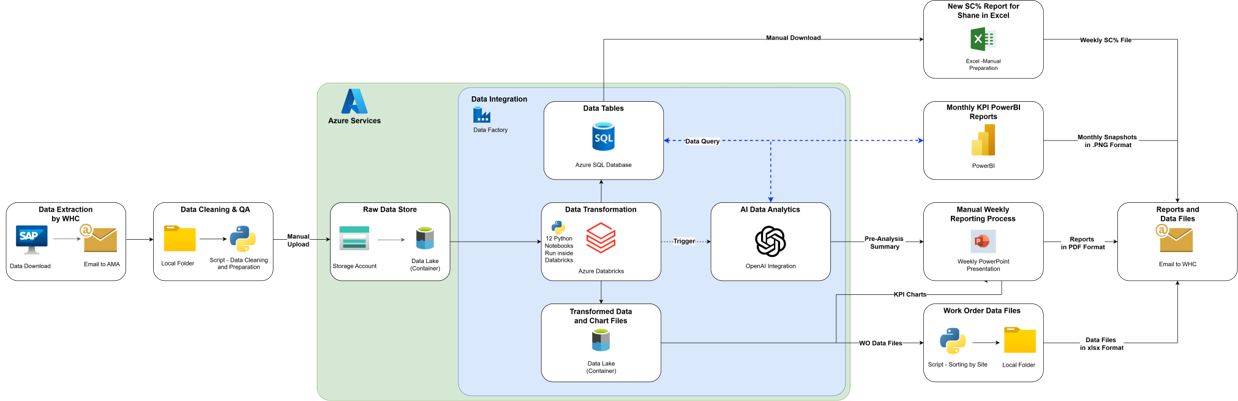
Image: Full Azure-integrated KPI Reporting Architecture
Azure-Based Data Ingestion Pipeline
Once the files were received, they were manually uploaded into an Azure Data Lake Storage (Gen2) container, serving as our raw data repository. Azure ensured secure, scalable storage while enabling seamless integration into downstream services.
Data Cleaning and Preparation
The next step involved Python-based data cleaning and QA scripts, executed locally. This included validation against SAP PM fields, data type checks, and compliance with business standards. Once validated, data was re-uploaded to Azure Data Lake as part of the Maintenance KPI Reporting.
Data Transformation in Azure Databricks
Using Azure Databricks, we ran 12 parameterised Python notebooks to transform the cleansed data into structured, enriched KPI datasets. A critical part of this process was understanding the new SAP S/4HANA phase model process, which introduced changes to how maintenance requests and work orders are initiated, planned, and executed. This understanding allowed us to map lifecycle status codes accurately and reflect real operational states across the KPI metrics as part of the Maintenance KPI Reporting.
- Work Order Compliance (% Planned vs Actual Hours)
- Backlog Ageing (Age brackets >7, >14, >28 days)
- PM Compliance (Scheduled vs Completed)
- Overdue Maintenance Requests count
These were mapped to ISO 55001 principles and standard maintenance KPIs used in asset-intensive industries.
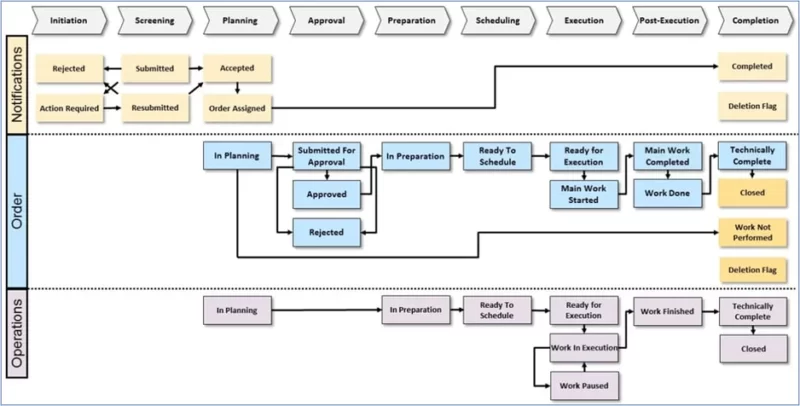
Image: S/4HANA New Phase Model Process – release 2022.
Azure SQL Database for Structured Storage
Transformed results were pushed to an Azure SQL Database, enabling historical tracking, querying, and integration with other reporting tools. SQL was chosen for its structured schema enforcement and compatibility with enterprise BI systems.
OpenAI Integration for KPI Observations
For deeper insight generation, OpenAI’s GPT-based model was triggered by Databricks notebooks to analyse trends and summarise KPI performance. These included:
- Commentary on weekly trends
- Highlights of top and bottom performing work centres
- Suggested root causes and next steps
This natural language generation helped streamline the report creation process.
Dual Output: PowerPoint + Power BI Dashboards
The final results were distributed in two formats:
- PowerPoint Reports: Traditional weekly reports were auto-populated and exported in PDF format for executive distribution.
- Power BI Dashboards: An interactive dashboard provided users access to historical KPIs, trend visualisation, and compliance analytics.
Both outputs helped align operations and planning teams with a consistent performance narrative.


Images: Sample PowerBI Dashboards
Outcome & Benefits
- Reduced manual intervention, moved away from spreadsheets and manual calculations
- Improved data quality and standardisation
- Actionable insights delivered faster
- Consistent reporting through automated workflows
- Centralised historical data stored in SQL DB for trend analysis and audit purposes
- Reusable data accessible for other business intelligence and reporting needs
This Azure-native architecture enabled a scalable and sustainable KPI reporting system for asset performance, aligned with the organisation’s ISO 55001 asset management objectives.
Keywords: Asset Performance, Work Management KPIs, SAP S/4HANA Maintenance Data, Azure Data Lake Storage Gen2, Maintenance KPI Reporting, Azure SQL Database, Azure Databricks, Data Transformation, Data Integration, Predictive Maintenance, ISO 55001, OpenAI GPT Integration, Power BI Dashboards, Automated KPI Reporting.
Need to transform your asset data into actionable insights? Contact AssetPRO Consulting to learn how we can help modernise your maintenance and reliability reporting systems.